


Secure Your Fertility Options for the Future.
At our hysteroscopy for infertility treatment center in Noida, we offer top-notch care for couples facing infertility. Our specialists utilize a variety of treatments, including a minimally invasive procedure for diagnosing and addressing issues within the uterus. Using advanced technology and modern techniques, we are committed to helping you fulfill your dream of starting a family. Schedule a consultation with our experts today and take the first step toward achieving your parenthood aspirations.
Fertility Preservation For Cancer Patients In Noida
At our center for fertility preservation for Cancer Patients in Noida, we offer a range of services aimed at providing patients with comprehensive diagnosis, treatment, and care. We have the necessary facilities and expertise to provide our patients with the best possible treatment.
Every treatment decision is shaped with 20+ years of proven clinical experience
Trust
25,000+
Happy Families
Result
78%+
IVF Success Rate
Positive
1,650+
Google Reviews
Heritage
20+
Years of Experience
What is Hysteroscopy?
Sometimes, fertility concerns may be linked to changes inside the uterus that are not always clearly visible on a routine scan. A hysteroscopy procedure allows the fertility specialist to directly examine the uterine cavity and identify concerns that may need further evaluation or treatment.
Hysteroscopy treatment may be recommended as part of fertility evaluation when clinically appropriate, helping your doctor understand the uterine cavity before planning the next step in treatment.
Hysteroscopy for Infertility Treatment
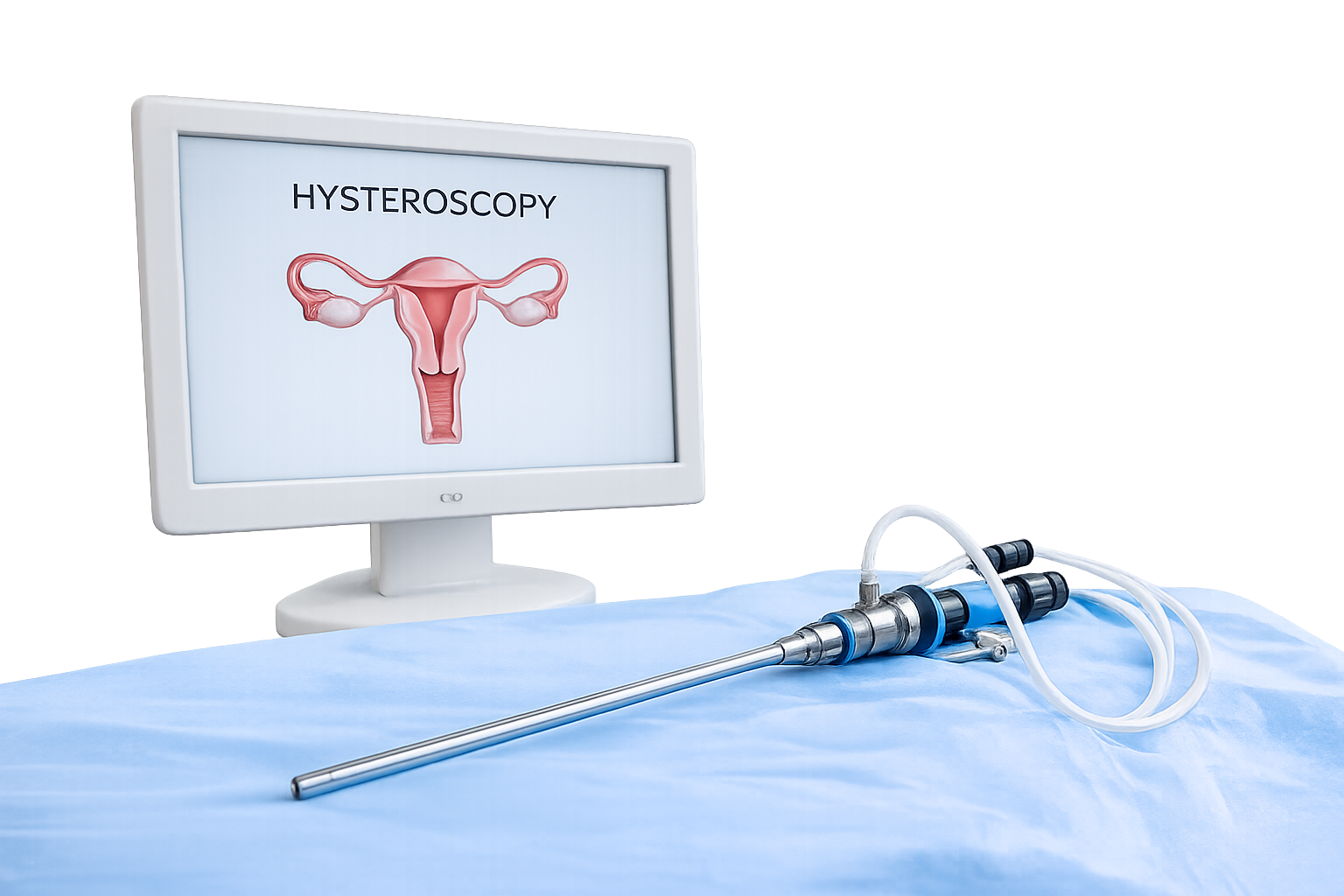
Hysteroscopy for infertility is a minimally invasive procedure in which a thin, lighted instrument called a hysteroscope is gently passed through the vagina and cervix to view the inside of the uterus.
- Diagnostic Hysteroscopy
Diagnostic hysteroscopy allows the doctor to directly examine the uterine cavity when an abnormality is suspected. - Operative Hysteroscopy
If an abnormality is identified, operative hysteroscopy treatment may be used to treat selected conditions such as uterine polyps, submucosal fibroids, adhesions or certain uterine septa, depending on the individual diagnosis. - Fertility-Focused Evaluation
Our fertility specialists review your medical history, previous scans, fertility treatment history and symptoms before deciding whether hysteroscopy is clinically relevant to your treatment plan.
— TREATMENT PROCEDURE
Hysteroscopy Procedure Step-by-Step
The exact hysteroscopy procedure can vary depending on whether it is being performed for diagnosis or treatment.

Preparation
Before the procedure, your medical history is reviewed and appropriate checks may be performed.
Pain Relief or Anaesthesia
Depending on the type of hysteroscopy and individual circumstances, the procedure may involve simple pain medicine, local anaesthesia, sedation or general anaesthesia.
Preparing the Cervix
You will be positioned similarly to a pelvic examination. Depending on the technique being used, the doctor may gently access the cervix before introducing the hysteroscope into the uterus.
Insertion of the Hysteroscope
A thin hysteroscope with a light and camera is gently passed through the vagina and cervix into the uterine cavity. The camera allows the doctor to view the inside of the uterus on a monitor.
Expansion of the Uterine Cavity
Sterile fluid is introduced into the uterus to gently expand the cavity. This creates space and allows the doctor to examine the uterine lining more clearly.
Examination
The doctor examines the uterine cavity for findings such as polyps, submucosal fibroids, adhesions or other structural abnormalities that may require further management.
Biopsy or Treatment
If clinically required, a small tissue sample may be collected. During hysteroscopy surgery, selected polyps, fibroids or adhesions may also be treated using fine instruments.
Completion and Recovery
Mild period-like cramps, light spotting or watery discharge may occur afterward. Recovery depends on the procedure performed and type of anaesthesia used.
What You Should Know
1. Hysteroscopy is not required for every fertility patient.
The hysteroscopy surgery is usually considered when there is a specific reason to examine the uterine cavity more closely. Your doctor may first recommend ultrasound or other investigations before deciding on the procedure.
2. Diagnostic and operative hysteroscopy serve different purposes.
A diagnostic hysteroscopy is primarily used to examine the uterine cavity. An operative hysteroscopy allows the doctor to treat certain abnormalities using fine instruments passed through the hysteroscope.
3. The recommendation depends on your individual fertility history.
Previous IVF treatment, recurrent pregnancy loss, unusual bleeding, suspected polyps, fibroids or adhesions may influence whether your fertility specialist advises hysteroscopy surgery as part of your evaluation.
4. Direct View of the Uterine Cavity
Unlike tests that create an indirect image, hysteroscopy tests lets the doctor directly inspect the inside of the uterus, helping identify certain abnormalities that may require further assessment or treatment.
Why Choose Zeeva Fertility?
Understanding the reason behind a fertility concern helps us plan the next step with greater clarity.

1. Individualised Fertility Care
Hysteroscopy is recommended only after understanding your symptoms, fertility history, previous treatment, and investigations. Our approach focuses on whether the procedure is relevant to your individual fertility plan rather than following a one-size-fits-all pathway.
2. Advanced Diagnostic & Treatment Support
Our fertility specialists use modern diagnostic and minimally invasive approaches to evaluate concerns within the uterine cavity and plan appropriate treatment when required.
3. Complete Fertility Care
Your hysteroscopy findings are considered alongside your complete fertility evaluation. This helps the fertility team plan further treatment based on your reproductive goals, medical history, and individual diagnosis.
Meet Our Fertility Experts
The Experts Guiding Your Journey
Dr. Shweta Goswami
Dr. Aarthi Mani
Dr. Shuchi Lakhanpal Kalia

Dr. Nidhi Tripathi

Dr. Shipra Gupta

Dr. Snehal Shah Mahajan

Dr. Mayank Sharma

Dr. Avnika Kapoor

Dr. Ayushi Bhardwaj

Dr Deepika Mann

— Our Centres
Quality Fertility Care, Now Near You
Our cutting-edge fertility centres across Delhi NCR — Noida, Delhi, Ghaziabad and Greater Noida
Zeeva Fertility, Sector 63, Noida
H 1A, 37, H Block, Sector 63, Noida, Uttar Pradesh 201301
(+91) 7669381393
10 am - 6 pm

Zeeva Fertility in South Extension, Delhi
3rd Floor, M-2, South Extension II, Block M, New Delhi, Delhi 110049
(+91) 7669381393
10 am - 6 pm

Zeeva Fertility, Sector 104, Noida
Zeeva Clinic, HA 103A, First Floor, Sector 104, Noida, Uttar Pradesh 201304
(+91) 7669381393
11 am - 1 pm & 5 am - 9 pm
Greater Noida to Gaur City 1 Greater Noida West
Zeeva Fertility, 9th Floor, NH-3, GH 01, Gaur City 1, Sector 4, Greater Noida west, Ghaziabad, Uttar Pradesh 201009
(+91) 7669381393
10 am - 1 pm
Zeeva Fertility in RDC, Ghaziabad
District Centre, RDC, Sector 15, Sector 10, Raj Nagar, Ghaziabad, Uttar Pradesh 201002
(+91) 7669381393
2 pm - 5 pm

Zeeva Fertility in Indirapuram, Ghaziabad
GF-01, 698, Niti Khand I, Indirapuram, Ghaziabad, Uttar Pradesh 201014
(+91) 7669381393
6 pm - 8 pm
What our patients are saying
Failed IVF
Natural Pregnancy
IVF
Tubal Blockage
Low AMH
IVF
Failed IVF
Ready to take the next step?
Talk to a Zeeva specialist — free, no pressure, clear options.
Our Blogs
Expert fertility insights
PCOS and Blocked Fallopian Tubes: Can You Conceive Without IVF?
Read More →
IUI vs IVF: How to Choose the Right Fertility Treatment in India
Read More →

Spotting Before Period: Causes and When to Worry
Read More →

IVF Success Rate कितना होता है? Age, AMH और Egg Quality का Role
Read More →


— Common questions
Fertility Questions, Answered
What happens during the procedure?
Our specialists will insert the scope through the cervix and into the uterus during the hysteroscopy procedure. This allows us to examine the uterus, fallopian tubes, and ovaries in great detail. We may also use special instruments to remove any polyps or growths that we find.
How long does the procedure take?
The procedure typically takes 30 minutes to an hour, depending on the case’s complexity.
Is the procedure painful?
Hysteroscopy is generally well-tolerated, and most patients experience minimal discomfort. We will provide pain medication to ensure your comfort during the procedure.
How long is the recovery time?
Recovery time varies depending on the individual and the extent of the procedure. Most patients can return to normal activities within a few days.
What are the risks of hysteroscopy?
Hysteroscopy and IVF is generally a safe procedure. Still, as with any medical procedure, there is a small risk of complications such as infection, bleeding, and injury to the uterus or other organs. Our team will discuss any potential risks with you before the procedure.
How much does the procedure cost?
The cost of a hysteroscopy procedure varies depending on the individual case and the extent of treatment required. We work with most insurance providers and will do our best to provide you with the most affordable option.